Why magnesium feels subtle until it doesn’t
The first clue is often something small: your calf tightens a little sooner on a run, your jaw feels clenched while you answer emails, or you wake up at 3 a.m. and can’t quite settle back down. Nothing is dramatic enough to point to one cause, so it’s easy to file it under stress, age, caffeine, or “just sleeping weird.” Magnesium can sit in that same fuzzy category—until the day your body feels noticeably less smooth, or you change your intake and suddenly something feels different.
Part of the subtlety is that magnesium isn’t a “kick” you feel right away. It’s involved in the background work of muscles releasing after they contract and nerves dialing down after they fire, so a small shortfall may show up as more twitchiness, more tension, or less forgiving sleep rather than a clear symptom. If your baseline intake has drifted down over months—more processed meals, fewer beans and greens, more sweating, more stress—the body can compensate for a while, and the signal stays quiet.
Then when intake goes up, the first noticeable change may not be mood or sleep at all—it may be digestion. A slightly looser stool or more regular bathroom pattern can appear before anything else, which can feel confusing if you were expecting “calm” and got “different.” That’s often the moment magnesium stops feeling theoretical and starts feeling like something your routine is actually touching.
Food versus supplements create different body signals
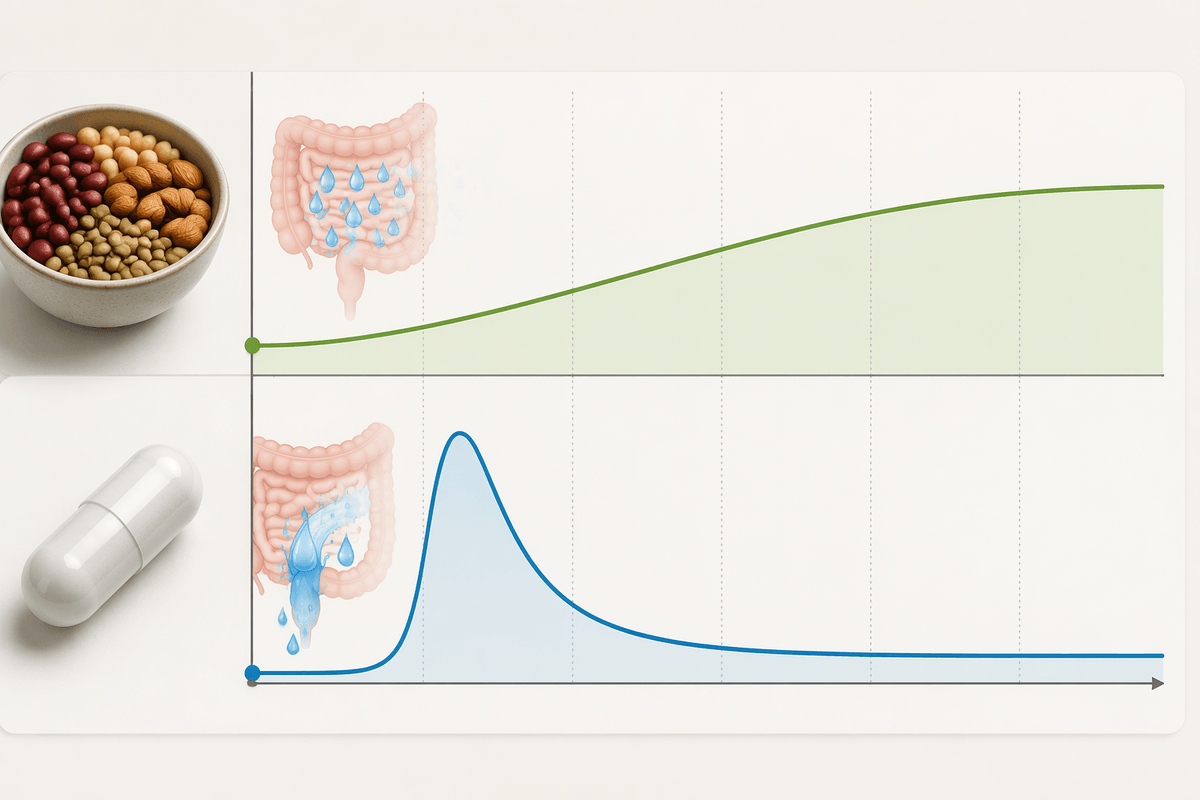
You might notice it at lunch, not at bedtime: a bean-heavy salad sits comfortably, but a magnesium capsule taken with coffee makes your stomach feel a little “watery” a few hours later. That difference can make people assume the supplement is “stronger,” when it may just be arriving in a simpler, more concentrated form—without the slowing, buffering effect of a full meal.
Magnesium from food tends to show up as a gradual shift because it’s packaged with fiber, protein, and other minerals that change how quickly your gut moves and how fast nutrients are absorbed. A handful of nuts, a bowl of oats, or lentils at dinner usually doesn’t announce itself. It’s more like your baseline settles over days: fewer little twitches, less end-of-day tightness, a slightly easier morning bathroom routine—though not always all at once.
Supplements, on the other hand, can create a sharper “signal,” especially in digestion. Depending on the form and dose, more magnesium can remain in the intestines and pull water in, which is why the first feedback is often looseness or urgency rather than deeper sleep. And because routines vary—capsule on an empty stomach, then a rushed workout—what you feel can be inconsistent enough to misread as the magnesium “not working,” when the body is simply reacting to timing.
Digestive shifts are common, sometimes confusing
It can start as a small timing problem: you sit down to work and realize you’ve already gone to the bathroom twice, or you’re traveling and suddenly your “usually constipated” pattern flips the other way. Because it doesn’t feel like cramps or sleep, it’s easy to blame the new smoothie, the restaurant meal, or nerves—then notice the only consistent change has been magnesium.
In some situations, magnesium creates its clearest signal in the gut because any portion that isn’t absorbed stays in the intestines, where it can draw water in and speed things up. That doesn’t mean something is wrong; it can simply mean your current dose, form, or timing is landing more like a gentle laxative than a quiet nutrient. This effect can come and go—stronger after coffee, after a hard sweat session, or when you take it without much food.
And if constipation was part of your baseline, “better” may not feel immediately better. A slightly softer stool, more gas, or a new sense of urgency can show up before regularity feels predictable. When digestion is the first thing to change, it’s a reminder that the body often responds in the most practical system first: the one that decides what gets absorbed, and what keeps moving.
Sleep, calm, and muscle tension may shift unevenly

It’s usually the middle-of-the-night wake-up that makes people second-guess everything: you open one eye at 3:07 a.m., your legs feel oddly “on,” and your brain starts replaying tomorrow’s to-do list. Then a few days after adding more magnesium, you might sleep longer—but still wake once. Or your shoulders feel looser at your desk, yet your calves cramp during a workout anyway. The change can feel real and still be uneven enough to mistrust.
That unevenness makes sense when you consider how many “inputs” feed those sensations. Muscles can feel less grabby when magnesium intake rises because it supports the release side of contraction, but sweat loss, long sitting, and higher caffeine can keep tension patterns going. Sleep can improve in a subtle way—less restless shifting, fewer jolts—without turning into immediate, effortless knock-out sleep, especially if stress hormones are still running high at bedtime.
Sometimes the calm shows up first in small moments: you notice your jaw isn’t as clenched during emails, or you don’t feel that electric leg twitch right as you’re drifting off. But if the gut side effect is still active—looser stool or urgency—that discomfort alone can pull sleep and “relaxation” back in the other direction. In real life, the signals don’t always arrive together, and that mismatch is often the most confusing part.
Energy and headaches: improvement, plateau, or no change
It can be the afternoon that tells the story: you finish lunch, reach for more coffee out of habit, and realize you’re not quite as foggy—or you’re exactly as foggy, which feels oddly disappointing when you’ve been “doing the magnesium thing.” With energy, the signal is easy to over-credit or dismiss because sleep, stress, food timing, and hydration can drown out small changes.
In some people, steadier magnesium intake may show up as fewer little “revved up” moments—less wired-tired jitteriness after caffeine, less post-workout drag—because nerves and muscles may settle with fewer misfires. But if digestion is still a bit loose, that alone can blunt energy, especially if you’re also losing fluids or avoiding food that used to keep you steady.
Headaches can follow the same uneven pattern. You might notice fewer tight, end-of-day headaches, then hit a plateau where they still show up on high-screen, low-sleep days. Sometimes the misunderstanding is timing: a new supplement routine changes your gut quickly, while headaches—if they shift at all—tend to move more slowly and inconsistently.
Interactions and trade-offs that shape the experience
The clue is often indirect: your usual morning coffee feels a little harsher, or a post-workout day that normally brings cramps instead brings a stomach that won’t quite settle. It can feel like the magnesium “changed,” when what really changed is the mix around it—caffeine, sweat, meal size, and stress all shifting the same few body systems at once.
Magnesium doesn’t land in isolation. If you’re sweating more, the same dose can feel less noticeable in muscles. If you take it without much food, it may stay in the intestines and pull water in, which can trade “calmer” for “urgent.” On the flip side, taking it with a heavier dinner might quiet the gut signal so much that you assume it isn’t doing anything, even if the background tension is slowly easing.
Medications and everyday routines add another layer of uncertainty. Some people are already juggling fiber supplements, antacids, or other minerals, and the combined effect can shift digestion or absorption in ways that don’t feel linear. You may have to decide which change matters more that week: fewer cramps, better regularity, or sleep that isn’t interrupted by your own stomach.
Recalibrating expectations when changes take time
A week in, the most noticeable “result” might be that you’re paying closer attention. You catch yourself wondering whether the quieter calf is from magnesium or simply from skipping a hard workout, or whether the calmer evening is real when the next night still includes one 3 a.m. wake-up. When the feedback is inconsistent, it’s easy to swing between “this is working” and “this is nothing,” even though small shifts rarely behave like a clean on/off switch.
Part of the waiting game is that the body tends to show the fastest signal in the place magnesium passes through first: the gut. Meanwhile, muscle tightness and sleep can lag because they’re shaped by patterns—stress load, caffeine timing, sitting, sweating, meal regularity—that don’t change just because intake went up. If digestion keeps flipping between “better” and “too loose,” that discomfort alone can blur any progress you would have felt elsewhere.
Over time, the more reliable clue is often what stops happening as often: fewer “grabby” moments after a long day, fewer twitchy jolts as you fall asleep, less of that tight-head feeling on average weeks. Not dramatic, not perfectly linear—just a slow re-baselining that’s easier to miss if you’re expecting a single obvious moment of calm.