Why multivitamins feel like an obvious health upgrade
It’s usually a small moment that makes a multivitamin feel necessary: you look back on a day of coffee, something packaged at your desk, and a late dinner that didn’t include a single vegetable. The bottle promises a clean fix for a messy week. One tablet, a little reassurance—especially when your meals are uneven, your appetite is off, or you’re cycling between “pretty good” and “barely anything.”
That appeal makes sense because “nutrients” sound like a simple checklist. If food was inconsistent, the logic goes, the gaps must be real—and a multivitamin must help. The catch is that many diets quietly include backups already: fortified cereals, plant milks, energy bars, and even occasional meal replacements can cover more ground than people realize. When that’s happening, the multivitamin may feel like an upgrade without changing much in your day-to-day functioning.
And because the pill is the same every day while your eating isn’t, the experience can get blurry. On weeks when your diet is tighter or more restrictive, it might truly be “insurance.” On weeks when your intake is already covered, the same habit can become redundant, or slowly push certain nutrients higher than you intended—without any obvious signal from your body either way.
What research measures versus what people actually feel

You might notice it most on a tired afternoon: you took the vitamin with breakfast, and there’s a quiet expectation that your energy should feel steadier. When it doesn’t, it’s easy to assume the pill “isn’t working”—or, on a better week, to credit it for a stretch of feeling more on top of things. Sleep, stress, hydration, caffeine, training, and how much you actually ate can easily swamp whatever small change a multivitamin could create.
Research usually isn’t measuring whether you felt sharper at 3 p.m. It’s measuring blood levels, deficiency rates, and longer-term outcomes that are slow to move—often in large groups where many people weren’t meaningfully low to begin with. If a study includes lots of participants already getting enough from food and fortified products, the average benefit can look flat even if a smaller subgroup was quietly filling real gaps.
People tend to judge the vitamin by immediate feedback, but the most plausible “wins” are often subtle: fewer recurring shortfalls when meals get repetitive, and less week-to-week variability when intake swings. If nothing in your routine is creating consistent gaps, the same pill can still feel responsible—without having much to change.
Where benefits cluster: gaps, life stages, diets
You notice it when you restock groceries: the “healthy” items you rely on are basically the same few things on repeat. That’s where multivitamins tend to matter most—not as a general upgrade, but when your pattern keeps missing the same nutrients. A week of uneven meals is one thing; months of a narrow rotation is another. The body can buffer some inconsistency, but not every shortfall evens out if the same food groups are rarely showing up.
Benefits also cluster around life stages and constraints that quietly raise needs or lower intake. Heavy menstrual periods, older age, intense training, appetite changes from stress, or long stretches of low-calorie eating can all shift the “gap” from occasional to recurring. The pill feels more noticeable here because it’s addressing a steady mismatch, not just a messy day.
Diets that cut whole categories—vegan, very low-carb, dairy-free, low-FODMAP, highly restricted for texture or GI comfort—can create predictable holes, but fortified foods can blur the picture. If your cereal, plant milk, and protein powder are already adding the same nutrients, a multivitamin may be doubling down rather than filling something new. That’s why two people can take the same bottle and have totally different odds of it actually changing anything.
Why broad benefits often disappear in large trials
It can be oddly deflating to read a headline that says multivitamins “didn’t help,” while your own routine feels like it should count for something. But large trials are built to detect broad, average shifts—across people with wildly different diets, different baseline nutrient status, and different amounts of fortification quietly baked into their food. When a big chunk of participants is already meeting needs, the ceiling is low: you can’t improve what isn’t meaningfully short, so the group average drifts toward “no effect.”
There’s also the timing problem. Many outcomes people care about—energy, immunity, “feeling healthy”—swing day to day, while the measurable endpoints in trials often move slowly and depend on more than nutrient intake alone. If the intervention is a standard one-a-day dose, it may be too small to correct a real deficit quickly, yet still enough to look redundant in someone already covered. Those two realities can cancel each other out on paper: a few people benefit, many don’t, and the signal fades into the background.
That’s why trial results can feel disconnected from real life. They’re not saying nutrients don’t matter; they’re showing how easily a mixed group turns a targeted tool into a low-impact average—especially when “covered” and “not covered” end up lumped together.
The formulation problem: doses, forms, interactions, timing
You notice it when you flip the label over and the numbers don’t match the story in your head. Some vitamins sit at 100% of the Daily Value, others jump to 300% or more, and a few key ones you assumed would be there are oddly low. A “one-a-day” isn’t a neutral baseline—it’s a specific recipe, built around typical deficiencies, marketing expectations, and what fits in a tablet.
The details matter because nutrients don’t behave the same way. Some forms absorb better than others, and minerals can compete for the same pathways, which can make timing feel surprisingly relevant. Taking everything together with coffee, on an empty stomach, or alongside a calcium-heavy breakfast can change what actually gets used. That’s part of why two people can take the same multivitamin and report different outcomes—even before you factor in sleep, stress, and appetite.
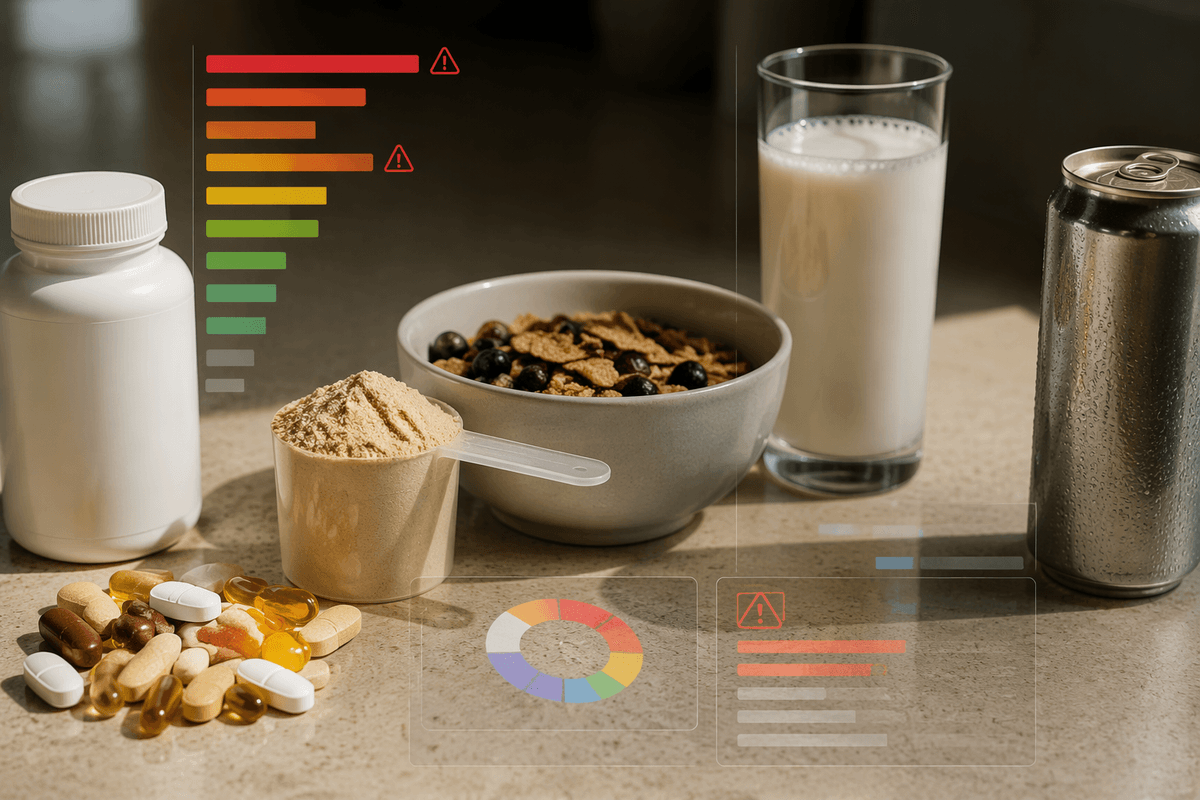
If your routine already includes fortified cereal, plant milk, energy drinks, or protein powders, the multivitamin can stack on top of that in a way that’s hard to “feel.” The confusion isn’t just whether the pill helps—it’s whether the formulation is filling a real gap, or mostly reshuffling numbers on paper.
When a reasonable pill creates unexpected confusion
It often shows up as a minor annoyance: the vitamin that seemed harmless suddenly makes your stomach feel a little off, or your urine turns neon and you wonder if that means it’s “working.” Neither is a clean signal. Some ingredients can be rougher without food, and some water-soluble vitamins simply spill over once short-term needs are met—noticeable, but not the same thing as better coverage.
A “responsible” routine can accidentally create overlap: a multivitamin at breakfast, a fortified cereal or plant milk, a protein powder later, maybe an occasional energy drink. On paper, that can push certain nutrients higher than you’d guess—especially the ones that are commonly added to packaged foods—while other nutrients you actually miss stay low because the multivitamin dose is modest or the form isn’t ideal for you.
So the pill starts to feel like it should be doing something, but the feedback is messy. If your meals are irregular, it may smooth out recurring gaps; if your week is already propped up by fortification, it may mostly add numbers you don’t feel, while the real limiter remains sleep, calories, protein, or just not eating enough variety to begin with.
A revised way to interpret “making a difference”
It’s easiest to notice on the morning you forget the pill and nothing obvious changes. That’s not proof it was pointless—it’s a reminder that “making a difference” often doesn’t feel like a switch flipping. When your baseline intake is already solid (including the quiet help from fortified foods), a multivitamin may mostly keep numbers from drifting, not create a sensation you can reliably detect.
A cleaner test is whether your week has a repeatable pattern that creates repeatable gaps. If your meals regularly compress into the same narrow rotation, or you cycle through low-calorie stretches, the vitamin is more plausibly acting like insurance. If your routine already includes multiple fortified products, the same habit may be redundant, and over time it can push a few nutrients higher than you intended—without any dramatic downside to warn you.
So “working” may mean something smaller: fewer true shortfalls during the weeks you’re least consistent. The frustration is that you won’t always feel that kind of coverage in real time, which is why the label can seem louder than your body’s feedback.